We redesign your business processes with AI.

AI Agents Are Changing the Ways of Doing Business Around the World
AI Agents are rapidly advancing from experimental AI applications to real business processes. Global research shows that companies are starting to move from pilots to real operations on Agentic AI.
Today, organizations are beginning to use AI agents not only to answer employees’ questions, but also across core business functions such as sales, customer service, manufacturing, software development, finance, operations, supply chain management, and knowledge management.
Business processes are being redesigned.
Enterprise AI pilots are gaining momentum.
Agents engage in real operations.
Companies are actively experimenting with AI agents.
AI Agent Transformation across Industries
Manufacturing & Industry
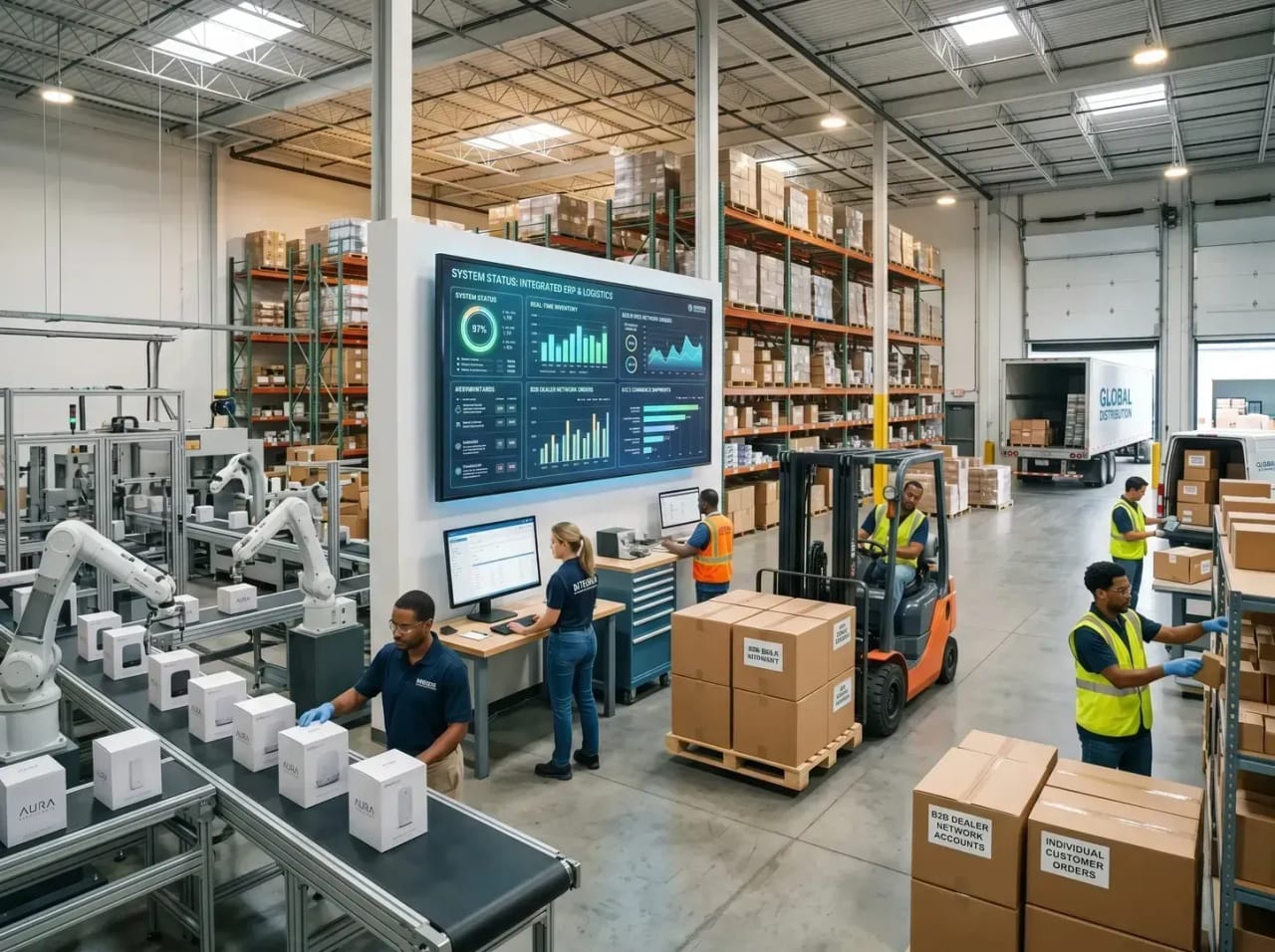
Production planning, predictive maintenance, quality and stock management. See the cause of problems and the action to be taken with ERP, MES and IoT data.
Finance & Insurance
Document processing, financial analysis, risk, compliance and collections. Agents that evaluate the data and advance the workflow within their authority.
Telecommunication
Manage high-volume processes from customer service to billing, from field operations to technical support.
Retail & E-Commerce
Product recommendations, order and stock management, personalized campaigns. Evaluate customer and product data in the same flow.
Healthcare
Provide support to teams in institutional information, patient communication, appointment and operations planning.
Technology & Software
Reduce repetitive work in code development, testing, bug analysis and IT operations; strengthen the focus of technical teams.
Production planning, predictive maintenance, quality and stock management. See the cause of problems and the action to be taken with ERP, MES and IoT data.
Document processing, financial analysis, risk, compliance and collections. Agents that evaluate the data and advance the workflow within their authority.
Manage high-volume processes from customer service to billing, from field operations to technical support.
Product recommendations, order and stock management, personalized campaigns. Evaluate customer and product data in the same flow.
Provide support to teams in institutional information, patient communication, appointment and operations planning.
Reduce repetitive work in code development, testing, bug analysis and IT operations; strengthen the focus of technical teams.

Enterprise AI Agents
- Sales Agent — Opportunity analysis, product recommendation, proposal preparation and customer tracking.
- Customer Service Agent — Meets requests and carries out order and support processes; escalates requests to the team when needed.
- Finance Agent — Invoice control, collection tracking and financial reporting.
- HR Agent — Support with candidate evaluation, onboarding and employee questions.
- Procurement Agent — Compares quotes and provides decision support with supplier performance.
How do we do it?
Stage 1 — Process Discovery and Agent Opportunity Map
This stage is not a consulting exercise, but a data-driven triage process.
- Process flow mapping (as-is analysis)
- Time and error cost measurement
- System dependency analysis (ERP, CRM, data warehouse, external APIs)
- Decision-point catalog, answering the question: ‘Who makes this decision and how?’
Prioritized use case list, expected ROI range and technical feasibility score for each.
Stage 2 — Agent Architecture Design
We design the Agent's tasks, decision boundaries, data sources it will use, and how it will work with other systems. We clarify which operations will be carried out independently and at which points human approval will be needed.
We create a defined task, controlled access and a traceable working structure for each Agent.
- Determining task, responsibility and decision boundaries
- Selecting the model, data source and tool
- Designing a single agent or multi-agent working structure
- Defining authorization, human approval and handover flows in case of error
Development-ready technical design that includes the Agent's workflow, system connections, data access rules, and human control points.
Stage 3 — Development and Integration
We develop the designed Agent; we establish connections with the institution's ERP, CRM, document systems and other business applications. We implement the steps of data reading, evaluation and transaction initiation according to the business rules of the institution.
We are preparing a basis to evaluate compliance with real processes with a controlled pilot application.
- Developing agent tasks, tools and workflows
- Establishing API integrations with ERP, CRM and corporate systems
- Preparing corporate information resources and applying access rules
- Developing transaction records, error management and human approval mechanisms
An agent application that can run the specified use case end to end, has the necessary system connections in place, and is ready for controlled testing.
Stage 4 — Testing, Simulation and Red Teaming
We test whether the Agent makes the right decisions, whether it complies with its authority limits and how it behaves in unexpected situations. We determine the risks before going live with real use cases and abuse experiments.
We evaluate success against measurable criteria such as accuracy, security, processing time, and cost.
- Conducting end-to-end scenario tests with real process examples
- Conducting red team tests with misleading instruction, unauthorized access and data leak scenarios
- Simulating missing data, system outage and incorrect response situations
- Evaluating accuracy, performance, cost and human approval flows
An evaluation report containing test findings, identified risks, required improvements, and acceptance criteria, providing a basis for the controlled go-live decision.
Stage 5 — Live Operation and Continuous Improvement
We deploy the agent into live use in a controlled manner; we track performance, task outcomes and user feedback. We improve workflows with real operational data and expand the scope of use according to new needs.
We manage live use as a development process fed by regular measurement and feedback.
- Gradual commissioning and transfer of use to operations teams
- Monitoring process success, response time, cost and error rates
- Analyzing user feedback and situations requiring human intervention
- Testing and publishing model, information source and workflow updates
Agent system whose performance is monitored, operation reports and prioritized development plan based on actual achievements.
Which of Your Processes Is Ready for AI Agents?

Artificial Intelligence Strategy and Consulting
01 / Discovery & Design We choose the most valuable use case and determine the process and data needs.
02 / Pilot & Validation We try the solution in real operation and measure its effect.
03 / Integration We connect the successful pilot to your systems and spread it throughout the organization.

Industrial AI Agents
- Production Agent — Compares planned and actual production; reveals the causes of capacity and performance deviations.
- Maintenance Agent — Supports the proactive work of maintenance teams by analyzing machine data and historical faults.
- Quality Agent — Identifies quality deviations, error patterns, and recurring production problems.
- Inventory Agent — Tracks raw material needs by evaluating production plan, stock and consumption data together.

Intelligent Automation
- Document Intelligence — Reads invoices, contracts and tender files; converts conditions and requirements into structured data. Initiates ERP and approval flows.
- Workflow Automation — Consolidates manual tracking into a single digital flow. Request → Control → Approval → Transaction → Notification
- Email Automation — Understands the email and initiates the correct process: converts the customer request into a CRM record and the support request into a ticket.

Knowledge & Executive AI
- “What are the payment terms of the last contract?”
- “Why are we behind the sales target this month?”
- “Show projects at risk of delay.”

Multi-Agent Systems
- 01 / Sales Agent — Analyzes the customer and the request.
- 02 / Inventory Agent — Checks inventory and capacity.
- 03 / Pricing Agent — Evaluates pricing rules.
- 04 / Finance Agent — Checks payment terms and financial criteria.
- 05 / Document Agent — Prepares the proposal in accordance with the corporate template.
- 06 / Approval Agent — Submits the proposal to the authorized manager for approval.
Connected to your systems. Under your control.
Our agents connect to your ERP, CRM, and enterprise knowledge sources, using role-based access, human approval for critical actions, and auditable logs.